
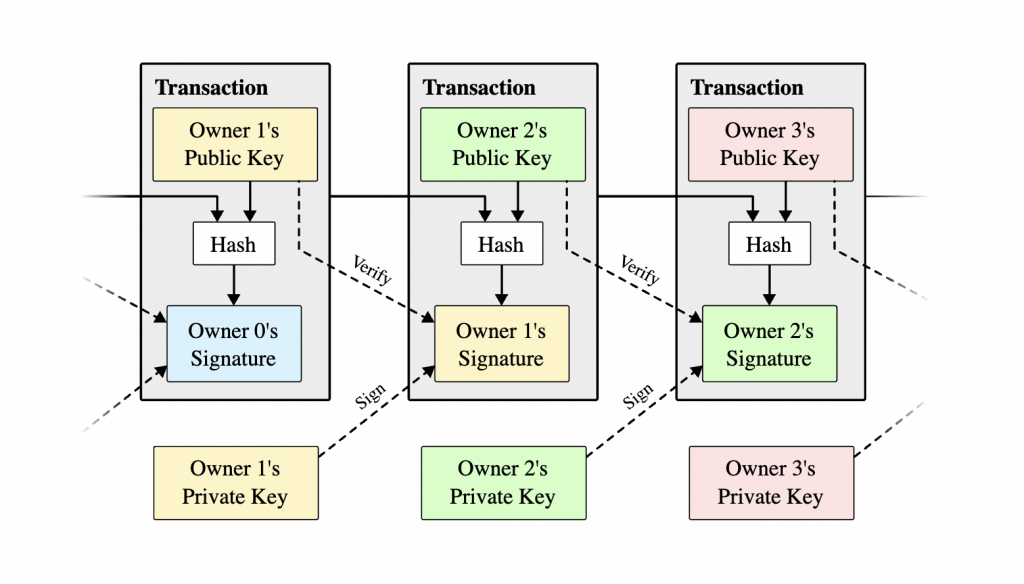
At its simplest, a Bitcoin transaction is just a transfer of value from one address to another. But under the hood, it is an elegant cryptographic process that ensures security, prevents fraud, and maintains the integrity of the entire network. Understanding how transactions work is key to understanding Bitcoin itself.
The Anatomy of a Bitcoin Transaction
Every Bitcoin transaction consists of three main components:
- Inputs: References to previous Bitcoin transactions that prove you have Bitcoin to spend. Each input points to a specific output from a previous transaction.
- Outputs: The destination addresses and amounts being sent. Each transaction can have multiple outputs (sending to multiple recipients).
- Digital signature: A cryptographic proof that the owner of the input addresses authorizes this transaction.
Think of it like writing a check: the inputs are your account balance (proving you have money), the outputs are who you are paying and how much, and the signature is your authorization.
UTXOs: The Building Blocks
Bitcoin does not use account balances like a traditional bank. Instead, it uses a system called Unspent Transaction Outputs (UTXOs). When you receive Bitcoin, you receive a UTXO – a discrete “chunk” of Bitcoin that can only be spent in its entirety.
For example, if you receive 0.5 BTC in one transaction and 0.3 BTC in another, you have two UTXOs: one worth 0.5 BTC and one worth 0.3 BTC. If you want to send 0.6 BTC to someone, your wallet must use both UTXOs as inputs (totaling 0.8 BTC) and create two outputs: 0.6 BTC to the recipient and 0.2 BTC back to you as “change.”
This is similar to physical cash: if you have a $50 bill and a $20 bill, and you need to pay $60, you hand over both bills and get $10 back in change.
The Transaction Lifecycle
Here is what happens when you send Bitcoin:
- Creation: Your wallet software creates a transaction by selecting appropriate UTXOs as inputs, specifying the recipient’s address and amount as outputs, and adding a change output back to your wallet.
- Signing: Your wallet signs the transaction with your private key, proving you own the Bitcoin being spent.
- Broadcast: The signed transaction is broadcast to the Bitcoin network, where it propagates from node to node.
- Mempool: The transaction enters the “mempool” – a waiting area where unconfirmed transactions sit until a miner picks them up.
- Mining: A miner includes your transaction in a candidate block and works on finding the proof-of-work solution.
- Confirmation: When a miner finds a valid block containing your transaction, it receives its first confirmation. Each subsequent block adds another confirmation.
Transaction Fees
Bitcoin transactions require fees. These fees serve two purposes: they incentivize miners to include your transaction in a block, and they prevent spam attacks on the network.
Fees are not based on the amount of Bitcoin being sent – they are based on the size of the transaction in bytes. A simple transaction (one input, two outputs) might be around 250 bytes, while a complex transaction with many inputs could be several kilobytes.
During periods of high network demand, fees can increase significantly as users compete to have their transactions included in the next block. During quiet periods, fees can be very low. Most modern wallets automatically estimate the appropriate fee based on current network conditions.
Confirmations and Finality
When a transaction is first included in a block, it has one confirmation. Each subsequent block adds another confirmation. In general:
- 1 confirmation: Suitable for small, everyday transactions.
- 3 confirmations: Considered secure for most purposes (about 30 minutes).
- 6 confirmations: The gold standard for large transactions (about 60 minutes). This is what exchanges typically require for deposits.
Each additional confirmation makes it exponentially harder to reverse a transaction. After 6 confirmations, reversing a transaction would require an astronomical amount of computing power – effectively impossible for any realistic attacker.
The Bottom Line
Bitcoin transactions are elegant in their simplicity: prove you have the Bitcoin, sign the transfer, broadcast to the network, and wait for confirmation. No banks, no intermediaries, no permission required. Just math and code working together to move value across the planet in minutes.